Sequences and properties
In formal verification, and also in PSL (Property Specification Language), we
pass either sequences or properties to the verification directives assert,
assume and cover.
This section gives simplified definitions of those, and how FVM helps to create them with the use of its helper tool drom2psl.
Sequences
We can think about a PSL sequence as a series of things that must be true
in consecutive clock cycles. Clock cycles are separated by ;, whereas :
separates different conditions that must be true in the same clock cycle.
For example, the following sequence happens when both M_Axi_WValid and M_Axi_WReady are true at the same time:
sequence transmission is {
  M_Axi_WValid : M_Axi_WReady
};
Whereas the following sequence happens if a is true on one clock cycle and b is true on the next clock cycle:
sequence a_then_b is {
   a ; b
};
Sequences can also receive parameters, for example the following sequence receives a parameter of type unsigned:
sequence overflow (
  hdltype unsigned count
) is {
  count = MAX_COUNT; count = 0
};
Using drom2psl to generate sequences
While PSL supports manually writing complex sequences using SEREs (Sequential
Extended Regular Expressions), the FVM proposes to use a helper tool,
drom2psl, to generate sequences from Wavedrom timing
diagrams.
From a Wavedrom waveform that looks like this:
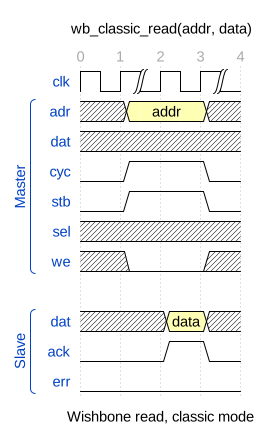
drom2psl takes its JSON description:
{
head: {text: 'wb_classic_read(addr, data)',
    tick:  0,
    every: 1,
    },
foot: {text: 'Wishbone read, classic mode',
    },
signal: [
    {name: 'clk',   wave: 'p|.|'},
  ['Master',
    {name: 'adr', wave: 'x3.x', data: 'addr', type: 'std_ulogic_vector(31 downto 0)'},
    {name: 'dat', wave: 'x...'},
    {name: 'cyc', wave: '01.0'},
    {name: 'stb', wave: '01.0'},
    {name: 'sel', wave: 'x...'},
    {name: 'we',  wave: 'x0.x'}
  ],
{},
  ['Slave',
    {name: 'dat', wave: 'x.3x', data: 'data', type: 'std_ulogic_vector(31 downto 0)'},
    {name: 'ack', wave: '0.10'},
    {name: 'err', wave: '0...'}
  ],
],
}
And converts it into a sequence, encapsulated into a PSL vunit (verification unit):
vunit wishbone_classic_read {

  sequence wishbone_classic_read_Master (
    hdltype std_ulogic_vector(31 downto 0) addr
  ) is {
    ((Master.cyc = '0') and (Master.stb = '0'))[*1]  -- 1 cycle;
    ((Master.adr = addr) and (Master.cyc = '1') and (Master.stb = '1') and (Master.we = '0'))[+]  -- 1 or more cycles;
    ((Master.cyc = '0') and (Master.stb = '0'))[*]  -- 0 or more cycles
  };

  sequence wishbone_classic_read_Slave (
    hdltype std_ulogic_vector(31 downto 0) data
  ) is {
    ((Slave.ack = '0') and (Slave.err = '0'))[+]  -- 1 or more cycles;
    ((Slave.dat = data) and (Slave.ack = '1') and (Slave.err = '0'))[*1]  -- 1 cycle;
    ((Slave.ack = '0') and (Slave.err = '0'))[*]  -- 0 or more cycles
  };

}
This vunit can be used from any user-defined .psl file just by using the
inherit keyword:
inherit wishbone_classic_read;
See section drom2psl for information on how to use the drom2psl
tool.
Properties
We can think about a property as a relation between two or more sequences, for example the following property relates the sequences wishbone_classic_read_Master and wishbone_classic_read_Slave:
property wishbone_classic_read (
  hdltype std_ulogic_vector(31 downto 0) addr;
  hdltype std_ulogic_vector(31 downto 0) data
) is
  always { {wishbone_classic_read_Master(addr)} && {wishbone_classic_read_Slave(data)} };
When relating sequences to create properties, we can use the following operators:
&&: both must happen and last exactly the same number of cycles&: both must happen, without any requirement on their durations|->: implication: both must happen, with the first cycle of the second occurring during the last cycle of the first|=>: non-overlapping implication: both must happen, with the first cycle of the second occuring the cycle after the last cycle of the first
By naming the properties, we are able to reuse them independently of whether they are intended to be asserted or assumed.
Usage with verification directives
We must keep in mind that the different verification directives can only receive either a sequence or a property:
assert: receives apropertyassume: receives apropertycover: receives asequence
Some examples follow:
assume_correct_read_module_A:
   assume wishbone_classic_read(addr_A, data_A);

assert_correct_read_module_B:
   assert wishbone_classic_read(addr_B, data_B) abort rst;

cover_read_from_specific_address:
   cover wishbone_classic_read_Master(x"90000000");
The abort rst in the assertion indicated that the property doesn’t need to hold true if the rst signal is asserted.